


That twinge in your knee when climbing stairs—the one that seems like nothing today—is what ends up in an operating room. And you're still in time to avoid it. A physiotherapist explains it — and what to do today so your knee doesn't end up there

Paula Méndez has spent years treating knees and is part of the team that created Ultimate Knees. What she told us explains why that knee warns you when climbing, why it doesn't fix itself, and what you can do today to stop it from wearing out.
If you no longer climb the stairs in your house the same way, this is for you. If you stop on the landing, if you look for the handrail, if there are days you don't even go outside. Paula describes her typical patient... and it's scary how accurate she is:

"Most arrive when they can no longer climb up to their house without stopping. And almost all tell me the same thing, half resigned: 'it must be my age'. I show them the knee on the screen and they understand it in a minute."
And you start shrinking your world: you stop walking outside, you choose places with no stairs, you stay home on the days you wake up feeling worse. The first thing Paula tells them is that it's not age, nor extra weight, nor is it your fault. And she shows it to them.
Claim Your Buy 1 Get 1 Free Offer"I know how you climb your stairs — even if you haven't told me"
You stop on the landing to look at your phone, just as an excuse. You go down sideways, holding onto the handrail. You get up from the sofa using both hands. And the knee keeps warning you, even if you weigh the same as you did ten years ago.

And you give it up for lost: you think it's age, weight, or genetics, and that this can't be fixed anymore. It's none of the three. What almost nobody knows is what is wearing it down. And it wears it down every single day.
Claim Your Buy 1 Get 1 Free OfferWhat you throw on it without realizing (and nobody ever explained to you)
"That knee has an enemy you can't imagine, and you wear it all day: your own weight, multiplied on every step."

When you go up, the knee acts as a hinge and a motor at the same time. And what takes the wear and tear is the cartilage, which has no blood supply. It feeds on movement, but if you move while bearing heavy loads, it wears out faster than it regenerates. Every step costs it double.
There, what should cushion the bone is crushed against the bone: the same friction, in the same place, every time you bend your leg. It's like a shoe sole you always step on the same way: at first you don't notice it; after months, you're left with no sole.
The math nobody has done for you
40 steps a day · 365 days a year: more than 14,000 steps a year with your knee carrying several times your weight. And your knee doesn't take a single day off.
That's why it hurts even if you don't gain a single pound, and that's why every year it hurts a little more. It's not age: it's what happens on every step.
And here the question arises naturally: "then, why did I use to go up without noticing?". Because for years that knee has been repairing itself overnight. Until it stopped doing so.
Claim Your Buy 1 Get 1 Free OfferFrom 55 onwards it no longer recovers on its own, and you need extra help before it's too late

This happens to everyone, even in their thirties. What changes from the mid-fifties onwards is that it stops compensating on its own. Until then, what wears out one day is repaired the next and leaves no trace.
From 55, that repair is slower and remains halfway done: what used to recover starts to stay damaged. A little bit every day. Nothing you notice from one week to the next... but a lot from one year to the next.
And reaching this point, normally you are already thinking about putting something on it. You might even have tried it: the orthopedic knee brace, the exercises you were told to do. Paula sees it every week in her clinic, and the first thing she explains is why neither of the two takes the weight off the knee.
Claim Your Buy 1 Get 1 Free OfferWhy the elastic knee braces they sell you won't take the weight off
If you look for how to get rid of knee pain, the first thing they will offer you are elastic knee braces, made of neoprene or fabric. They are not badly made: they are made to support. They squeeze, provide a little heat, and leave your knee feeling firmer for a while.

But an overloaded knee doesn't have a support problem: it has a weight problem. No bandage takes a single pound off it. And at $20–$40 each, they stretch out and you have to buy them again.
And the second thing they will tell you, if they haven't already, is to do exercises.
Claim Your Buy 1 Get 1 Free OfferAnd why exercises aren't enough either
Then there are the exercises: the ones the physio gives you, the ones from the internet video. Twenty minutes a day, if you do them, and the knee improves for a while. The rest of the day it goes back to loading the exact same way.

Both have something in common: they don't take the weight off. They work for a few minutes, and the knee works all day. Neither touches the hours when the knee actually wears out.
The problem isn't just that both fall short. It's that, while you try them, the steps keep adding up.
What happens if you keep loading it the same way
Every day like up to now means thousands more steps with the knee at its limit. Today the pain goes away with rest. In a few years it won't go away: the knee swells, fails when going downstairs, and what is a nuisance today ends up being a knee that doesn't support you.
And every year it gets harder to reverse it. That's when you start looking at quotes: injections that have to be repeated and, in the end, the operating room to get a knee replacement.

A patch that is repeated for years is not a solution: it's lost time while the knee grinds away.
So the question is no longer what you put on it. It's what is really happening to that knee. And that, in Paula's clinic, has a name.
Claim Your Buy 1 Get 1 Free OfferIt has a name: overloaded knee
In most people who arrive at her clinic, this has a specific name: joint overload. And the description says it all: it doesn't come from age or body weight. It comes from the load the knee supports on every single step you take.

Paula Méndez
Physiotherapist · from the team that created Ultimate Knees
"An overloaded knee is not fixed with rest. It is fixed by taking the weight off while you keep moving."
Paula proposes doing the math for your day. Exercises work for twenty minutes. The knee loads for four hours standing. That's why the first thing to do is not to buy another patch: it's to take the weight off while you walk.

And her advice is as simple as it is uncomfortable: the sooner you take the load off, the more knee you have left to save. Don't leave it for later. Start today.
And if what it has in excess is weight, the solution cannot be to simply squeeze it tighter.
Claim Your Buy 1 Get 1 Free OfferWhat does take the weight off: having something else push for you
Paula shows it with her hands. She lays you on the stretcher, holds your leg, and she pushes when you go up. And there you notice it: the knee bends and stretches without taking all the weight. The cartilage feeds instead of wearing out, and going up stops being an effort. What she does with her hands for ten seconds should be done by something all day, on every step.
But you can't carry a physical therapist behind you. That's what knee exoskeletons are for: an external frame with hinges and springs that pushes for you on every step. And the one she helped create is called Ultimate Knees.

And before showing you what it does, it's worth knowing where it comes from.
Claim Your Buy 1 Get 1 Free OfferWho is behind this exoskeleton
It wasn't released by a knee brace brand. The frame was developed in Germany by a group of engineers and physiotherapists, led by a now-retired physiotherapist.

And retired is the important word here. He spent forty years seeing people pass through his clinic to whom he could only offer patches — bandages, heat, exercises —, and upon retiring he did what he hadn't dared to do before: release something that fixes the root cause, without fear that the brands that live off selling you a new knee brace every six months would come after him. Because if this works, it makes them obsolete.
And the best thing is for you to see it in action, because in ten seconds it's understood better than in three paragraphs.
Claim Your Buy 1 Get 1 Free OfferWhat these exoskeletons do that no knee brace can do
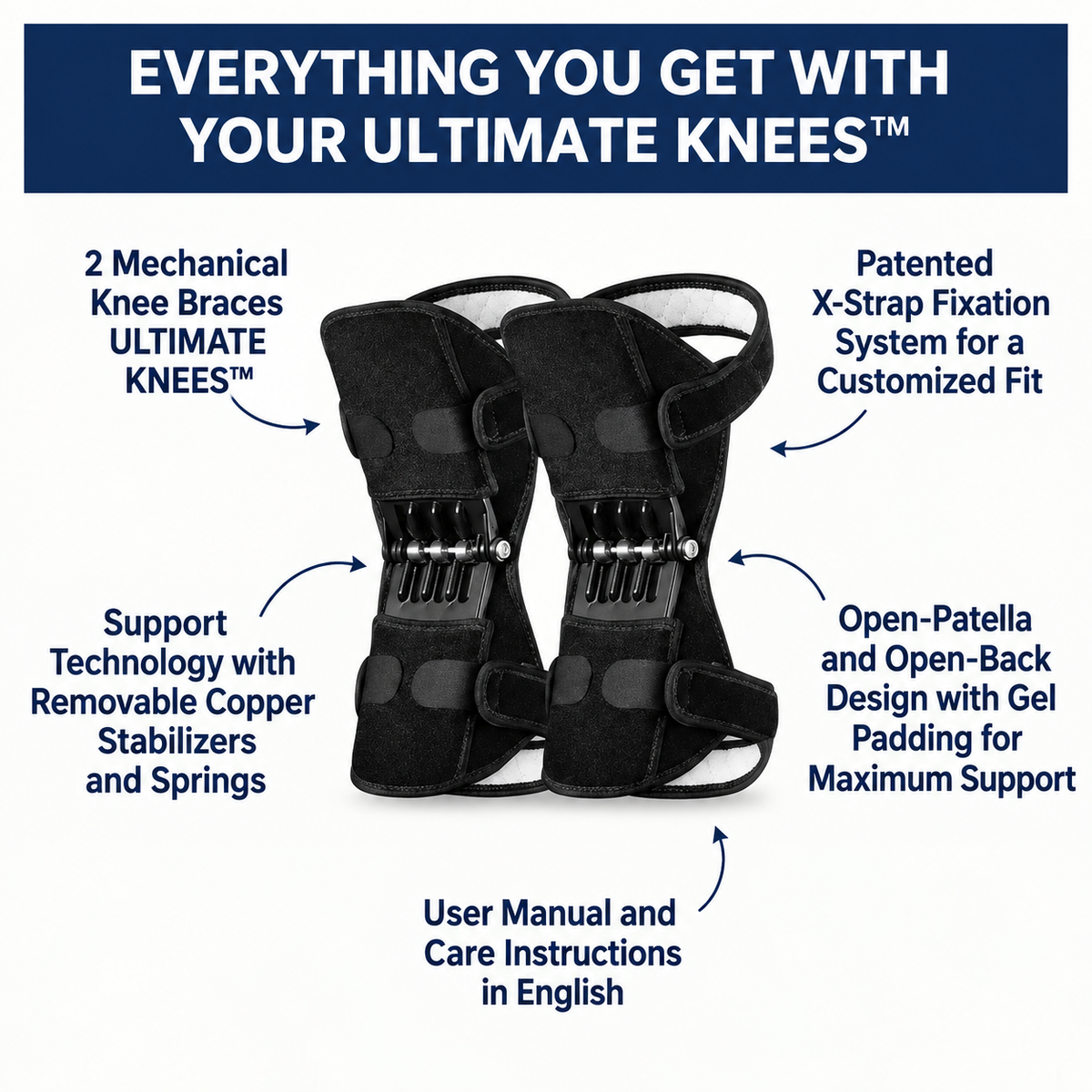
What you're seeing up there is the whole invention, and no knee brace does it: it flexes for you. The frame has a hinge on each side and three steel springs. When you bend your knee the springs load, like a coil; when you stretch, they release and push the leg up. And when going downstairs they act as a brake, so the weight doesn't fall suddenly on the joint. That's why in the video it works just as well for climbing a step, bending down to pick something up, or carrying weight: you don't have to remember anything, it works on every movement you make.

| What each knee brace does to your knee, every day | |
|---|---|
|
Traditional elastic sleeves Squeezes and provides heat, but the weight is still carried by the entire knee. |
✕ |
|
Neoprene with velcro Provides slightly more support, but still doesn't take a single ounce of load off. |
✕ |
|
With lateral splints Limits movement, but doesn't push: it only restricts. |
✕ |
|
Rigid orthopedic braces Immobilizes the knee, which is exactly the opposite of what it needs to heal. |
✕ |
|
Gel or magnetic pads Offers relief for a while but does nothing to unload the joint. |
✕ |
|
Spring-loaded exoskeletons (Ultimate Knees) Takes part of the effort on every step and leaves the knee unloaded all day. |
✓ |
All the ones above do the same thing: support. The only one that adds force where you've lost it is the exoskeleton, and that's why it's the only one that takes weight off the knee instead of just squeezing it. Before recommending one, Paula bends it with her hands: if it yields to hands, it yields to your weight. Going up and down, the knee is completely unloaded.

And while we're at it, it's only fair to tell you what you will notice and when, because this doesn't happen overnight.
Claim Your Buy 1 Get 1 Free OfferWhat is going to happen, day by day
This is not noticed all at once. The first few days it will feel strange, because your knee has spent years doing all the work itself. But from the first step it is unloaded, and you will go up the first flight of stairs without stopping.
Around the first week comes the first major change: you go up to your house without looking for the handrail. Around two or three weeks you return to the activities you had left behind: the long walk, grocery shopping on foot, going for a stroll without worrying about the walk back. And from there on, every day with the unloaded knee is one less day wearing it out.

Let's go back to the previous math
Knee braces and exercises work for a few minutes a day but fail during the hours you spend standing. Ultimate Knees costs less than two physio sessions and works on every step you take, every single day, exactly where the knee wears out. From then on, whatever exercise you do finally adds up to your recovery.
Paula insists on seeing it this way: not as just another knee brace, but as something that pushes for you all day long. You notice the knee is unloaded from the very first step, and over the weeks the change is seen where it matters most: in the things you are able to do again. And this is how it's worn:

But it's better if someone who has been climbing their stairs with them for a few months tells you their story.
Claim Your Buy 1 Get 1 Free OfferThose who got their active lives back
 David R., 63 · TexasVerified Purchase
I had knee surgery and was left with a fear of stairs. The very first day I noticed I was going up without holding on, and after three weeks I went back to taking long morning walks. I have found a new life in my knees.
212 people found this helpful
 Helena F., 58 · FloridaVerified Purchase
I had been buying $30 knee sleeves for two years that stretched out in a month. With this one I go up to my apartment in one go, which is four flights of stairs. My husband says I'm walking like I used to again.
184 people found this helpful
 Andrea P., 55 · CaliforniaVerified Purchase
It's not magic: the first few days it feels weird. But by the end of the week I wasn't even thinking about my knee going up, and after a month I did my whole Sunday hiking route. No exercise had given me that.
251 people found this helpful
They all say the same thing, each in their own way: what changes is not the age of your knee, it's what you are able to do with it again.
Claim Your Buy 1 Get 1 Free OfferWhat your day is like when your knee is unloaded

You go up to your house in one go. You go for groceries without calculating distances. You join the weekend plans even if there's a hill. And the knee is still there, but it no longer dictates your life.
An honest note from Paula Méndez: if your knee swells drastically, locks, or fails suddenly, your doctor needs to see that. Here we are talking about the knee that overloads and grinds down over the years.
"It wasn't age. It was the weight your knee carried on every step. And that can be taken away today." — Paula Méndez
Over 2,000 customers are already walking with Ultimate Knees
See what Ultimate Knees customers across the country are saying
96% of those who try it would recommend it to a friend
★★★★★
Anthony G., 64 years old — Phoenix, AZ
My brother-in-law recommended it to me after seeing me go up sideways holding onto the handrail. I had tried two elastic knee braces and a pain cream, and all they did was squeeze. This one actually pushes: I go up the three floors without stopping on the landing.
★★★★★
Manuel R., 67 years old — Austin, TX
Forty years on scaffolding and my knee taking its toll. With the springs I literally notice something pushing me up when I climb, I'm not making it up. I wear it under my jeans and nobody notices.
★★★★★
Brenda S., 59 years old — Orlando, FL
My doctor told me my issue was wear and tear and that I should lose weight. With this I have been able to walk every single day again, which is exactly what I couldn't do because of the pain before.
★★★★☆
Raymond A., 61 years old — Denver, CO
I give it four stars because the first three days I felt the springs and it felt weird. I held out for a week and now I never take it off: I go up the hill to my house without stopping to catch a breath.
★★★★★
Charlotte M., 57 years old — San Diego, CA
I had spent two summers without going to the beach because of the promenade stairs. I bought it based on the reviews and I would do it again in a heartbeat: I go down and up, slowly, but I go down and up with no pain.

30-day trial. 100% money-back guarantee.
Try it for a whole month on your stairs, the real ones, your everyday ones. You do the comparison, with your own legs.
Either you notice your knee unloaded from the first day, or we refund every cent, no questions asked.
We can risk it because we know what happens when someone tries it: fewer than 3 out of 100 return it.
🎁 Customer Appreciation Event: Buy 1 Get 1 FREE! We know knee pain rarely affects just one side. Order today and get a complete pair (one for the left knee, one for the right) for the price of just one!


NATRAVOR™ Ultimate Knees – Climb stairs and walk with knee support from the very first step, or your money back (30-day trial) *One size fits all and washable
NATRAVOR™ Ultimate Knees – Climb stairs and walk with knee support from the very first step, or your money back (30-day trial) *One size fits all and washable
BUNDLE & SAVE
Couldn't load pickup availability

NATRAVOR™ Ultimate Knees – Climb stairs and walk with knee support from the very first step, or your money back (30-day trial) *One size fits all and washable


What they're saying on Facebook
Frequently Asked Questions about Ultimate Knees
Why does my knee hurt when climbing stairs?
Because when you climb a step, your knee doesn't just support your body weight: it supports several times your weight. Over the years, the cartilage wears down and warns you right there—when going up, going down, and getting up. Ultimate Knees doesn't just mask that warning: it takes away part of the strain with a spring-loaded frame that pushes for you.
Aren't elastic knee sleeves or exercises enough?
Elastic knee sleeves squeeze and provide warmth, but your knee still bears all the weight. Exercises help for twenty minutes a day, but your knee is loaded for the rest of the hours. This is the only thing that works on every single step you take.
Does it fit either leg and any size?
Yes. It's a universal size: it adjusts with two velcro straps, one above the knee and one below, and fits both the right and left leg. The pack includes two, one for each knee.
How long does it take to notice a difference when climbing stairs?
Your knee is unloaded from the very first day, even though you might feel the springs for the first few days. By the first week, you'll be going up without reaching for the handrail, and by two or three weeks you'll be back to taking long walks. Everyone goes at their own pace.
Why does it cost more than a normal orthopedic knee brace?
Because it's not just a knee sleeve: it's an exoskeleton. It features a hinge on each side and three steel springs that return the push on every step. A $30 fabric sleeve just squeezes and stretches out in a month; this unloads the joint and is built to last.
Is it noticeable under pants?
Barely. The frame has a low profile and sits close to the leg, so it hardly shows under regular pants. Many people wear it outside all day without anyone noticing.
How do I pay?
On delivery: you can pay at your door, in cash or however you prefer, once the package is actually in your hands. No need to pay in advance online.
How long does shipping take?
Between 24 and 72 hours nationwide. Free shipping, with tracking included.
What if it doesn't work for me?
You get a real 30-day trial. If you don't feel your knee unloaded, write to us and we'll refund 100% of your money. We take the risk, not you.